


Hi BenGreat to see toxie and fuzzel chiming in here. Wonderful to hear VPVR will be baked into VP11 when the time comes!
After ten years of service from my old GTX 750ti based machine, I finally decided to upgrade to a Core i7 / GTX 2060, with the express purpose of jumping on board with VPVR. New machine arrived this weekend. Got VPVR up and running! This first post is to just explain how easy it was to create a fresh installation of VPVR for anyone who might be interested in joining the fun. I'll post a separate "thank-you" message later (That'll probably be a long post, too!).
Installation process was smooth. I watched this instructional video. Recommended for VPVR newbs, like myself:
Caligula also has a helpful "Getting Started" post on his VPVR sourceforge page. The first instruction is to get "regular VP" up and running on your machine. Since this was a fresh install, I used the "all in one" VPX installer. Interestingly, the all in one installer did not give me the option to choose 64bit VPX vs. 32bit VPX (unless I missed it). I believe it installed the 32bit version.
Next instruction was to install VPVR and drag those uncompressed files into the "regular" visual pinball folder. I'm using a single monitor on this new computer (I'm still running my cabinet with a separate old computer), and chose installation options accordingly. Everything was pretty straightforward.
Third step for me was to get Oculus Link up and running for the first time. I installed Steam and the Steam VR extension. I downloaded Oculus Rift (even though I'm using a Quest, the Rift software is the only variant available for PC from Oculus). I unboxed my new 10 foot "Party Link" cable. It's USB C on both ends, but came with a USB C to USB 3.0 adapter. I couldn't for the life of me get my PC to recognize my Quest. I tried every single USB port on the machine. Finally, I found a Reddit thread that advised making sure the silk-screened side of Party Link cable USB 3.0 adaptor lines up with the silkscreened side of the Party Link USB C cable end. I'd done that. What was the problem? Just to make sure, I popped the adapter off, flipped it around the other way and snapped it back on. Bingo! Computer recognized the Quest. Green light. My cable adapter was simply silkscreened on the opposite side. Had no idea "which direction" you plug in a USB cable matters. Hope this helps someone. Cost me over an hour of trial and error and some doubts that I'd chosen the right gear!
Once the Oculus Rift software recognized my Quest the next step was to launch Steam VR. That was easy. I bumped the supersampling up to 150% (as I'd read people are getting good results) within the Steam VR settings.
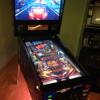
Next I downloaded Arconovum's FSS mod of Bord's Pinbot table. I'm pretty sure Arconovum's FSS tables still require the associated backglass file to be renamed to same name as table file and placed in the VP tables folder, just like with regular VP. I did that. With Oculus Rift software running on PC, Quest connected via Party Link cable, and Steam VR runnning, I launched the VPVR app. I got a black screen. I was thinking it wasn't working. Then I checked over my right shoulder. Pinbot was "half way across the room." Ha! I took my computer keyboard over to the cab (I'd mapped the buttons earlier using JoyToKey) and pressed the zero key to recenter (this feature is fantastic -- I can't see how you guys got by without it early in development!). Mind was instantly blown.
Zen pinball on Quest gave me VR pinball fever. I really want Zen to know that their platform and ours can co-exist peacefully -- indeed that VPX is more or less an "advertisement" for their proprietary stuff. I buy all things Zen. Pinball FX2 on the Quest got me excited enough to buy a new computer to try VPVR. Boy, am I glad I did! I couldn't believe my eyes. Pinbot looks incredible in VPVR. VPX physics (which I already loved on the cab) make "even more sense" in VR. Everything translates so well. I had high hopes, and in most ways VPVR has exceeded my expectations. Can't believe this is "alpha" software!
Way to go Devs!
Since the Quest is not a native PC VR headset super sampling does not work on it that way it does on basically any of the PC VR headsets. In fact, when link came out there was no way to super sample on the Quest.
I believe the only way to super sample on the quest is to follow these instructions as Oculus added the ability to SS the quest in a somewhat recent update and the process only works on a Quest.
The good news is you can probably get the picture looking better than what you currently have

I know DJRobX has tried this so maybe he can chime in on how much of a difference it made for him and what settings he used etc. if you are interested.
https://youtu.be/TgvFfsx0qAw
Edited by gear323, 03 February 2020 - 06:57 PM.
 Top
Top









 Contributor
 First we will release a VP10.7 and after that we think about starting VP11....


 are all trademarks of VPFORUMS.